Showing posts with label Stock market trading. Show all posts

Sunday, July 7, 2019

Success comes from knowledge trader should 2019


Success comes from knowledge – this is true for most things in life and especially Forex trading. To become successful, a trader needs to learn technical analysis. Technical indicators are a big part of technical analysis.
The problem is that, at first sight, names of technical indicators can sound unpleasantly complicated, for example, MACD, RSI or Stochastic. However, we recommend you not to judge a book by its cover. We will provide you with a fair and simple explanation of the most popular technical indicators. We guarantee that you will understand how to use them. Are you interested? Let’s start then!

Do technical indicators actually work?

We trade to get a positive result or, in other words, profit. Many beginner traders are eager to know whether technical indicators are able to give them good trading signals.
The truth is that technical indicators won’t automatically lead you to profit, but they will do a lot of work for you. There are no doubts that a skillful and experienced trader can achieve profit without indicators, but they can still help a lot.
In fact, technical indicators can do a few wonderful things:
  • show something that is not obvious;
  • help to find a trade idea;
  • save time for market analysis.
Every technical indicator is based on a mathematical formula. These formulas make fast calculations of various price parameters and then visualize the result on the chart. You don’t need to calculate anything yourself: just go to MetaTrader menu, click on “Insert” and then choose an indicator you would like to add to the chart.
At the same time, technical indicators make their calculations only on the basis of a price – the currency quotes, which are reordered in the trading software. As a result, indicators do have weak spots: they can give signals which lag behind the price (for example, the price has already fallen when the indicator finally gives a signal to sell).
The good news is that there are ways to get a lot of benefits from technical indicators. We are going to explain how to do it in the paragraph that follows.

The best technical indicators for Forex traders 

Technical indicators are divided into several groups depending on their purpose. As purposes of the indicators are different, a trader needs not one, but a combination of several indicators to open a trade. In this article, we will tell about the 3 most popular technical indicators.

1. Moving Average – an indicator to identify the trend

Moving Average (MA) is a trend indicator. It helps to identify and follow the trend.
Technical principle: MA shows an average value of a price over a chosen time period.
In simple terms: Moving Average follows the price. This line helps to smooth the price volatility and get rid of the unwanted price “noise”, so that you focus on the main trend and not on corrections. It is necessary to understand that this indicator does not predict the future price, but outlines the current direction of the market.
Advantages of Moving Average:
  • identifies a direction of a trend;
  • finds trend reversals;
  • shows potential support and resistance levels.
Disadvantages of Moving Average:
  • lags behind the current price (will change more slowly than the price chart because the indicator is based on the past prices).
Tips:
  • There are 4 types of the Moving Averages – simple, exponential, linear weighted and smoothed. The difference between them is merely technical (how much weight is assigned to the latest data). We recommend you to use Simple Moving Average as most traders use this line.
  • The most popular time periods for MA are 200, 100, 50 and 20. 200-period MA may help to analyze a long-term “historical” trend, while the 20-period MA – to follow a short-term trend.
How to interpret
In short, a trend is bullish when the price of a currency pair is above the MA and bearish – when the price falls below. In addition, note how Moving Averages with different periods behave towards each other.
Upward bias is confirmed when a shorter-term MA (e.g. 50-period) rises above the longer-term MA (e.g. 100-period). And vice versa, a downward bias is confirmed when a shorter-term MA goes below the longer-term MA.


2. Bollinger Bands – an indicator to measure volatility

Bollinger Bands helps to measure market volatility (i.e. the degree of variation of a trading price).
Technical principle: Bollinger Bands consist of 3 lines.  Each line (band) is an MA. The middle band is usually a 20-period SMA. It identifies trend direction – just like the MAs described above do. Upper and lower bands (or “volatility” bands) are shifted by two standard deviations above and below the middle band.
In simple terms: Bollinger Bands indicator puts the price in a kind of box between the two outside lines. The price is constantly revolving around the middle line. It can go and test levels beyond the outside lines, but only for a short period of time and it won’t be able to get far away. After such deviation from the center, the price will have to return back to the middle. You can also notice that during some periods of time Bollinger lines come closer together, while during other periods of time they spread and the range becomes wider. The narrower the range, the lower is market volatility and, vice versa, the bands widen when the market becomes more volatile.
Advantages of Bollinger Bands:
  • The indicator is actually great in a sideways market (when a currency pair is trading in a range). In this case, the lines of the indicator can be used as support and resistance levels, where traders can open their positions.
Disadvantages of Bollinger Bands:
  • During a strong trend, the price can spend a long time at one Bollinger line and not go to the opposite one. As a result, we don’t recommend Bollinger Bands for trending markets.
How to interpret
The closer the price approaches the upper band, the more overbought the currency pair becomes. To put it simply, by this time buyers have already made money on the advance of the price and close their trade to take profit. The result is that the overbought pair stops rising and turns down. The price's rise above the upper band may be a selling signal, while a decline below the lower band – a buying signal.
The outer bands automatically widen when volatility increases and narrow when volatility decreases. High and low volatility periods usually follow each other, so the narrowing of the bands often means that the volatility is about to increase sharply
Tips:
  • We don’t recommend to use Bollinger Bands without confirmation from other indicators/technical tools. Bollinger bands go well with candlestick patterns, trendlines, and other price actions signals.
Conclusion
Bollinger Bands work best when the market is not trending. This indicator can be a great basis for a trading system, but it alone is not enough: you’ll need to use other tools as well.

3. MACD – an indicator that shows the phase of the market

MACD (Moving Average Convergence/Divergence) measures the driving force behind the market. It shows when the market gets tired of moving in one direction and needs a rest (correction).
Technical principle: MACD histogram is the difference between a 26-period and 12-period exponential moving averages (EMA). It also includes a signal line (9-period moving average).
In simple terms: MACD is based on moving averages, but it involves some other formulas as well, so it belongs to a type of technical indicators known oscillators. Oscillators are shown in separate boxes below the price chart. After an oscillator rises to high levels, it has to turn back down. Usually so does the price chart. The difference is that while MACD needs to return close to 0 or lower, the price’s decline will likely be smaller. This is how MACD “predicts” the turns in price.
How to interpret
  1. Dramatic Rise/Fall. Sell when histogram bars start declining after a big advance. Buy when histogram bars start growing after a big decline.
  2. Crossovers between the histogram and the signal line can make market entries more precise. Buy when the MACD-histogram rises above the signal line. Sell when the MACD-histogram falls below the signal line.
  3. Zero line as additional confirmation. When MACD crosses the zero line, it also shows the strength of bulls or bears. Buy when the MACD-histogram rises above 0. Sell when the MACD-histogram falls below 0. Note though, that such signals are weaker than the previous ones.
  4. Divergence. If a price rises and a MACD falls, it means that the advance of the price is not confirmed by the indicator and the rally is about to end. On the contrary, if a price falls and MACD rises, a bullish turn in the near-term.
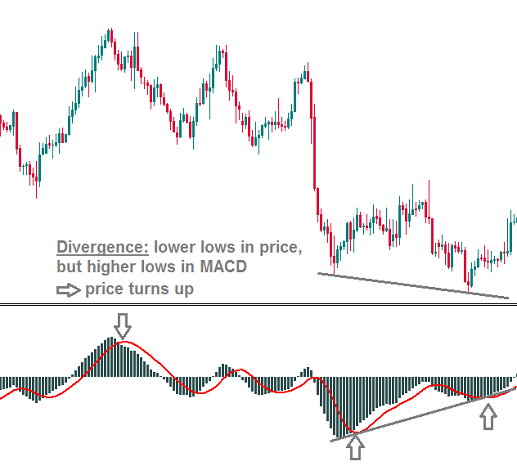
MACD forex indicator
Tips
  • Crossovers between the histogram and the signal line are the best signal from MACD.
  • Hunt for divergences between MACD and the price: it’s a good indication of an upcoming correction.
Advantages of MACD:
  • MACD can be used both trending or ranging markets.
  • If you understood MACD, it will be easy for you to learn how other oscillators work: the principle is quite similar.
Disadvantages of MACD:
  • The indicator lags behind the price chart, so some signals come late and are not followed by the strong move of the market.
Conclusion
It’s good to have MACD on your chart as it measures both trend and momentum. It can be a strong part of a trading system, although we don’t recommend to make trading decisions based only on this indicator.

What have we learned about technical indicators

  • Technical indicators have both advantages and disadvantages.
  • One technical indicator won’t give you a good trading signal. You need to use 2-4 indicators for trading.

Wednesday, September 13, 2017

United States, which will keep the markets with the mixed dollar


Hi friends, good day. Tuesday's session will be limited by US Independence Day, which will keep the markets without American activity.

However, there were interesting movements in the previous hours,
 with a dollar that does not manage to assert itself against the main currencies, although with mixed behavior in some crosses that project it upwards for the rest of the week.

In this context, the euro is yielding positions from its close to 1.1430 on Monday, presenting a bearish correction that, as long as it remains above 1.1275 (61.8% of the last bullish move), will have room to return to grow. However, the rise that brought the euro to the level mentioned does not have much support in the news. Only a few comments by ECB President Draghi on a likely cut in stimulus plans for the economy should not, in principle, push the single currency much higher. It should be noted that the ECB rate remains zero, while that of the Fed increases periodically, and is already in the range of 1 to 1.25%.


The Sterling, meanwhile, after a strong bearish correction on Monday, grows again at the date, despite some data known in the UK at first that did not favor. Exceeding 1.2950, ​​a little unlikely because of the low turnover, will lead the pound to 1.30 again, a level that violated last week.

The yen, meanwhile, grew up in the first hour, led by versions that North Korea launched a missile in Asian time. Since these versions are still not confirmed, and there is a lot of confusion about this, the yen growth slowed at 112.73, the USD / JPY pair is again bullish. However, the yen seems to have free ground to recover for the rest of the week.

Strong have been, with hours difference, the decreases of the ounce of gold and the Australian dollar. The precious metal gave up more than $ 20 at the start of the week, and it will take time to recover. Only the $ 1240 break, unlikely at this time, could give it a bullish boost.

As for the Aussie, it lost positions after the announcement of the RBA's monetary policy statement, which left the interest rate unchanged. The later text did not conform to the markets, which punished the Australian dollar with a decrease greater than 120 points from the highs of last week.


Little is left for this Tuesday. Probably see a recovery of the dollar until the closing of the European session, against the euro and the yen, and a rise of the pound. The best thing is, then, to analyze the markets to return to the activity early Wednesday.

USDSELLBUYACTUALS1S2R1R2
AUD0.75800.76350.76060.75850.75500.76300.7655
CAD1.29451.30051.29751.29501.29301.30001.3030
EUR1.13201.13701.13441.13251.12951.13651.1395
GBP1.28801.29551.29141.28851.28501.29451.2980
JPY112.90113.40113.17112.95112.70113.35113.60
CHF0.96300.96840.96510.96350.96100.96800.9700
MXN17.940018.100018.024017.960017.880018.080018.1600
GBP/JPY146.05146.65146.35146.10145.80146.60147.00
EUR/JPY128.00128.75128.43128.10127.70128.70129.00
ORO1218.001234.001225.101220.001214.001232.001240.00

TRANSCRIPTION OF THE PREVIOUS DAILY COMMENT

Hi friends, good day. It ends the month with a weakened dollar on almost all fronts, as a result of the changes in course central banks are promising for the rest of the year.

Among them was highlighted this week the presentation of the head of the Bank of Canada, Poloz, who spoke directly to raise interest rates of the entity in the coming months. Currently, the reference rate is at 0.5%, after having been cut last for May 2015.

The Canadian dollar reflected the words of the official with a strong growth that he experienced especially since Wednesday, being, along with the euro, the currency that best behavior has shown in this last part of the month. Its current price is 1.2972 against the dollar, below the strong level of 1.30, which won with eye-catching ease in the last hours.

However, the publication of the GDP of Canada, which will take place at 8:30 in the east, could put a brake on the Loonie. This country is one of the few that measures its GDP on a monthly basis, and publishes its figures about 60 days after the end of the month analyzed. The forecast is a 0.2% increase, compared to the previous 0.5%, a significant drop that could lead to a trend change in the USD / CAD in the short term.

The 4-hour chart of this cross shows a level of over-sale that invites you to take upward positions. Exceeded the level of 1.30, now firm resistance, 1.3030 and 1.3075 will be the targets to consider.


The rest of the currencies could accompany this likely bearish correction of the Canadian dollar. The euro stretched its gains to 1.1446 in the first hour, this being the highest value of the single currency in the year, and a year to date. While still trading above 1.14, the near 1.1390 ​​break could open the door to a major bearish correction in the EUR / USD pair, with the following supports at 1.1370 and 1.1340, representing 38 , 2% of the last bullish movement of the crossing.

The British pound, which at times topped 1.30, retraced its steps in the last few hours, and while maintaining a short-term bullish trend, could also correct in the opposite direction during the American session. Two data already known in the United Kingdom that did not significantly change the pound (current account and final GDP in the first quarter), the current price of 1.2978 is half way between a larger increase, which could crystallize alone to the break of 1.3005, and a modest low, below 1.2950.

In yen, it moves with strong speed in these hours, and at the moment recovers almost 100 points from its minimum of 112.89 the day before. The 4 hour chart is neutral, with no clear direction for the American session. But the break of 111.70 could lead to a favorable yen movement for the rest of the day, which will target 111.30 in its case.

The day's agenda, which includes the usual end-of-month data such as spending and personal income figures, Chicago PMI and University of Michigan / Reuters consumer confidence, will not radically change the outlook.

Friends, have an excellent day of operations, and a very good weekend and month. We meet again next Monday, until then.


Sunday, March 5, 2017

For advanced users trading forex indicators 2017

Indicators for users advanced


This article is written by Rudolf Wittmer, specialist in systems of
trading in Germany

Indicators for advanced users

Part 3: Adaptive moving average. An indicator linked to the trading

The dream of every trader is to get an indicator which in time will indicate the beginning or the end of a trend. After all, the strategies of
trading that earn lot of money during the trend, return
part of the benefits during the stage side. Due to the
most traders use tracking of trends that models
they use moving averages with constant parameters during both phases. Their
systems are designed in a static way. So, what is it that most
approaches to the use of indicators whose parameters evolve from
dynamically and adapt automatically to the conditions


Adaptive approach

The main disadvantage of the moving average (MA) is the amount of time
up to the beginning of a trend. A trend only be displayed if the
movement of prices is greater than the statistical variability of the
underlying these price data. Perry Kaufman speaks of "noise
White"in his 1995 book"Smart Trading". This phenomenon, which is
It is known as the art of the vibration, characterizes the daily random fluctuations caused by the numerous decisions of the different market participantsA moving average, so it can display only one
trend if there has been one movement greater than this noise
(volatility). Otherwise, the strategy would produce too many signals
false. The approach to adaptation is after the following considerations.
An indicator shall not show a trend direction when the market moves back and forward without direction. The MA will not move in
this case will remain off. This can be achieved with a MA, have a long period of time.If after she starts a trend-based phase, the
indicator should also quickly display this movement. For MA
It would mean that the length of the current period should be relatively
short. Ideally, therefore, would be an MA that changes your period
} with the proportion of the noiseOne of the indicators of adaptation more
popular is the average mobile adaptive (loves) which describes in detail Perry Kaufman in his book, and that are going to see with more detail below..

Adaptive approach

The main disadvantage of the moving average (MA) is the amount of time
up to the beginning of a trend. A trend is only displayed if the
movement of prices is greater than the statistical variability of the
underlying these price data. Perry Kaufman speaks of "noise
White"in his 1995 book"Smart Trading". This phenomenon, which is
It is known as the art of the vibration, it characterizes the fluctuations
random daily caused by numerous decisions of the different
participants of the marketA moving average, therefore, only be able to display a trend if there has been one movement greater than this noise
(volatility). Otherwise, the strategy would produce too many false signals. The approach to adaptation is after the following considerations. A
indicator should not show a trend direction when the market moves back and forward without direction. The MA will not move in this case, will remain off. This can be done with a MA, have a
long period of time. If after she starts a trend-based phase, the indicator also shouldshow quickly this movement. For me, it would mean that the length of the current period should be relatively short.
Ideally, it would therefore be a MA changing his period with l
proportion of the noiseOne of the most popular indicators of adaptation is the Adaptive moving average (AMA) which describes in detail Perry Kaufman in his book, and that we will see in more detail below.


Efficiency index

If a market moves quickly in one direction, the noise is no longer so
important. However, if the market moves back and forward without direction, the noise is of crucial importance. Therefore, the choice of the length of the period depends on the trend and volatilityThe index of
Efficiency (ER) combines these 2 properties. For its calculation (ER), the difference inprice between the beginning and the end of the period considered is divided based on the sum of the net price movementsThe procedure for the
calculation of the ER is shown graphically in Figure 1. The greater the
value of the ER, easier will be the movement. An ER index of 1 means that the pricemovement has occurred only in one direction
(no movement against). An index equal to 0 ER means that the values
start and end are the same. The higher the ER, faster and
directional will be the trend. The smaller the ER, the greater the volatility of the market.


Constant smoothing (SC)


For the calculation of the Adaptive moving average (AMA), you must use the ER
in order to calculate the constant c. The calculation of the AMA is carried out from
Similarly to the calculation of the XMA, the smoothed exponential moving average:

XMA: XAverage (closing, length)
= XAverage [1] +
X factor (close - XAverage [1])
AMA: AMA (closing, length)
= LOVE [1] + cx (first love [1])

The difference between the AMA and XMA is that c-smoothing "constant" is not constant, but can be changed by the ER as a function of the
existing volatility. This means that "c" is the Adaptive part of the AMA,
that fits the display according to the market conditionsTo an equal to 0 ER, you must use a slower MA and for an ER equal to 1, a faster MA. Therefore, the ER is used to scale in the range between shorter and longer wavelengths. To do this, the lengthof the period is converted to "c-smoothing constant"This is done with the following formula "2 / (length + 1)", used in the calculation of the XMAIf a value of 2 is selected as the
the period length shorter and a value of 30 as the length of the longest period, areobtained then 0,667 and 0,0645 valuesThe MA
slower has the largest value, la faster MA has the value more
small. The scaling is done according to the formula:


ER x (fast c - slow c) + slow c


As "almost-c" and "slow c" are consistent, the term gets bigger
Depending on the size of the ER. In the case of strong tendencies, the ER is
becomes very large, so that, according to the formula of the AMA with
regarding the value of the previous AMA, add greater valueWADA
changes according to the trend. If, on the other hand, the ER is small, East
It is the case in volatile lateral movements, only a very small value is added to the previous AMA. In this case, the AMA does not change as much as
It might be possible and runs horizontally. The calculation of the "c-smoothing constant" is reproduced in the information box. In a final step, you
softens the squaredGiven that all used values are less than 1, the constant will go faster to 0. Which means that the more slower are used more often than the fastest.The general approach is more
conservative.
The full program of the AMA with Easy Language code can be
displayed in the information box.


Practical example

Figure 2 shows the AMA (blue line) compared to an MA in
period 20 (red line), using the example of the DAXThe characteristics of the AMA are very well illustrated. Request that the indicator does not move markets side met in ideal cases. We can see it in the graph during the period from the end of January,mid-April and almost all of May. On the other hand, a trend-based phase to a lateral phase transitions are almost erratic, so also the second requirement is met
for a quick response to a phase shift.

Conclusion

With WADA we have introduced the concept of the indicator "intelligent", able to recognize the different stages of the market and react accordingly. Purely visual, this indicator promises very good results and by the
Therefore it is regarded as a staple of any trading system. In addition, the operational presented with indicator of adaptation is not limited to
the application of moving averages, but can also be applied to other
indicators such as the rate of relative strength (RSI) * or the impulse *, etc.