Showing posts with label forex. Show all posts

Saturday, January 20, 2024


The common currency today Tuesday extends its gains against the dollar continuingits rally started last April 25 maximum 1.1616 in mid European session, reaching level quoted for the last time on August 25 last year. Breaking important psychological1.1500 figure rising encouraged buyers to take long on this pair positions, and insurance many stops of short positions must have been executed to transpose such a barrier, combination of factors that injected much fuel to the bullish engine greatly increasing the speed with which moved the quote. Accordingly, when these "stretches" the price usually retract similarly due to poor sustainability of shopping and the profit taking that also takes place here, turning this way alarm lights for long at the present level positions.

Being this immediate stage, in the weekly chart is observed clearly that quote has formed a perfect double floor (DS) figure (blue box) and is currently transiting a bullish channel that accelerates its impulse buyer, with possible target at 1.1700 (T1) which is the maximum of the DS figure quoted on 23 August 2015. Although the upwardtrend is firm and oscillators accompany harmonically the price, accumulated by thepair overbought levels need to be cleared, which in principle could lead to a momentary retraction of short term from the current level to the 1.1500 control area and to1.1400 in extension. It is very important to control these two supports, since his break down could put at risk the validity of the figure of double floor and as a result thisanalysis would also lose its validity. Therefore, and in my opinion, waiting for takinglong positions at a level lower that today enjoys greater probability of success for the weekly frame.

What is Forex Trading?


 To answer the question of what is currency trading or Fx trading, we are going to break down and define both terms:


The term trading is the activity through which one product is exchanged for another. You can trade with countless instruments: forex, commodities, indices, stocks, cryptocurrencies, etc.

The term Forex refers to the market in which some currencies are exchanged for others, as well as other types of financial instruments.


So, what is Forex trading? Forex trading is an activity, or even a profession, through which currency pairs are bought and sold to speculate on the rise or fall of the price of said pairs.


This activity is open to anyone who has a computer and internet access. Forex trading is a type of daily and international trading. States or companies (institutional trading), even individuals, like you, operate with currencies every day.


This trading is carried out through computer networks between traders around the world. This is the main reason why Forex is the largest and most liquid market in the world and the most accessible.


How Forex Trading works

The general logic is simple. Everyone who starts trading has the following question in mind: how to make money in Forex. The trader or operator of this market buys something when he believes it will go up in value, or sells it short when he thinks it will go down in value.


For example, let's imagine that the euro today is worth 1.2345 dollars. Once the market has been analyzed, the trader thinks that this value will increase in the next 24 hours. He opens a buy trade today and waits. The next day the euro is worth 1.2395 dollars and the trader closes the order, making a profit of 50 pips.


How much money does this represent?


It will depend on the volume of money that the trader has invested in that specific operation. The profit could be either $5,000 or $50,000.


However, delving deeper into the previous example, we see that things are a little more complicated. Let's start from the beginning to learn how to trade Forex.


How to Trade Forex with CFDs

CFDs are the product that has transformed the financial market into what it is today.


In the old days of Charles Dow there was no such trading. Investment only. Buying shares of a company with potential was the only possibility investors had. Should those shares rise in value, they could be sold and a profit would be realized. However, if they started to depreciate, probably, even if they wanted to sell them, no one would want to buy them.


To help your training, we are going to define some of the basic terms of Forex Trading with CFDs.


Terminology of Forex Trading with CFDs

To solve the question of how to operate Forex we need to be clear about some key concepts, since they constitute the basis of this activity:


currency pair

It is a key concept within the fundamentals of trading Forex. To make it simpler and within the context of Forex trading, imagine that currency pairs are a single financial instrument.


When looking at the EUR/USD pair or any other quote on your trading terminal, you will see two numbers:


The sale price (bid)

The purchase price (ask)

Which are shown this way: EUR/USD 1.05154/1.05162.


This quote implies that:


You can buy 1 euro with 1.05162 US dollars, the purchase price.

You can sell 1 euro for 1.05154 US dollars, the selling price.

Trading in the foreign exchange market works as follows. Imagine you want to buy euros and sell US dollars. When you press the buy button, your broker borrows a portion of the funds in your trading account as insurance for the transaction.


After a while, you close the order, assuming that the market moved in the direction you expected, that is, the euro increased its value compared to the dollar or the latter depreciated compared to the euro. At this point, your broker sells you the euros that appreciated in exchange for dollars that are now worth less.


There are two things you should keep in mind about Forex trading: first, traders sell currencies that they do not actually own; second, in each transaction a purchase and a sale take place; the two sides of the coin. For that reason it is a currency exchange.


These are the fundamentals of trading Forex in relation to the mechanical part.


Purchase order

In Forex trading, when a buy order is placed on, for example, the EUR/USD pair, a portion of the funds in the trader's account are used to purchase the base currency of the pair, in this case the EUR, and sell the pair's quoted currency, the USD. The price is expected to increase and thus make profits.


The broker carries out this transaction, which is called placing a purchase order. The order is placed either with the broker (market maker) or by communicating it directly to the Forex interbank market (ECN execution), which is where the large market participants are located.


When the profit satisfies the trader, he will close the order and the broker will carry out the opposite transaction, that is, he will sell euros and buy dollars.

Sale order

The reverse process, this is called short trading, the trader will first open a sell order. The reason is that the trader, once analyzing the market, considers that the price of the instrument is going to decrease, so he first places a sell order, and once the desired profit has been accumulated, he closes the position with a buy order. .

It is the minimum unit of change in price and simultaneously one of the most popular terms within the fundamentals of Forex trading.


When the selling price of the EUR/USD pair goes from 1.1234 to 1.1235, it means that it moved 1 pip.


Pips are the simple way for traders to calculate profits or losses, since their value depends on the volume of the operation.


Operation volume

It is the size of a position within the market and is measured in lots. When the transaction volume corresponds to 1 lot (100,000 units of the base currency), 1 pip is equivalent to 10 units of the quoted currency. For example, when trading 1 lot of the EUR/USD pair, 1 pip is equivalent to 10 USD.


Spread

The spread is the difference between the buying and selling prices. As you read above, a quote is the comparison between these two prices. The purchase price will always be higher than the sale price.


The spread is the reason why there is always a small negative balance when placing an order. In addition, it is one of the concepts to take into account when trading Forex, since it will influence the profits or losses that the trader may have.


Margin

Simply put, it is the amount of money the trader invests in a position. A retail Forex trader is not likely to have enough margin to trade the market directly, as the minimum limit is 100,000 currency units. That is why leverage is used.


In an example without leverage, if a trader wants to open a position of 1000 EUR and the current EUR/USD exchange rate is 1.250, how much money does the trader trade with? with 1250 dollars. If the trader has 2000 dollars in his account, this 1250 dollars will be taken from his account, this is known as margin. This margin is retained until the position is closed. *Note: the free margin is the result of subtracting 2000-1250= 750.

Leverage

It is another essential term to understand Forex trading. Leverage is a money multiplier. For example, a leverage of 1:100 can turn a €100 account into one that controls €10,000 of a currency pair, making even the smallest fluctuations in price profitable.


However, keep in mind that leverage is an opportunity that also comes with risks, since the amount of margin available has a directly proportional relationship with currency price variations. Therefore, if the market moves against you, it will affect the available margin in your account in real time and, if you do not have enough funds, the broker will liquidate your position, since it will not be able to keep it open.


Based on our previous example, if the trader's leverage is now 1:100, this implies that the trader contributes 100 times less, so the margin for the same trade would be $12.5.

Free margin

It is the difference between the account balance and the sum of the margins of the open positions.


Margin level

It is the (equity/margin) *100. When the level is 100% it means that equity and margin are equal. Therefore, the trader does not have free margin to operate (open more operations). This is called a margin call. When you trade Forex it is very important to observe this indicator, since it can prevent you from opening new operations. You can monitor it on your trading platform.


We assume an account with a balance of 10,000 euros, with a margin of 1,000 euros. If this position accumulates 9000 euros of losses then your margin is equal to your balance, that is, 1000. This is the margin call.

Stop Out

The Stop Out is the minimum margin level from which the broker begins to close your open positions.


Trading account

Account offered by the broker to the Forex trader to operate.


Trading Platform

Software offered by the broker to the trader so that he can access the market and operate.


Do you want to know more about Forex trading? You can see all this terminology related to currency trading in more detail in the following YouTube tutorial:

As Forex trading emerged and grew with the development of the Internet, so did retail traders seeking additional information to excel in their trading potential.


This led to the birth of a large number of forums on Forex Trading that have a considerable number of active contributors, being able to find information about this market in almost any language. Since the market operates 24 hours a day and 5 days a week, there are Forex traders from all over the world.


In addition to the aforementioned forums, Forex traders can find various media and different new ways to communicate. Although there are a wide variety of Facebook groups about Forex trading, this market has evolved into something bigger, as there are many social networks designed especially for traders.


Is this why Forex is so social?


Not really. There's still more. Forex trading has evolved beyond pure communication to action. Forex is a very interesting market because it gave rise to what is known as social trading.

Risk Notice: The data provided provides additional information with respect to all analyses, estimates, forecasts or other similar evaluations or information (hereinafter "Analysis") published on the websites of Admirals investment companies operating under the Admirals trademark (hereinafter "Admirals"). Before making any investment decisions, pay close attention to the following:


1.This is a marketing communication. The content is published for informational purposes only and should not be construed in any way as investment advice or recommendations. It has not been prepared in accordance with legal requirements intended to promote the independence of investment reports and is not subject to any prohibition on trading prior to the dissemination of investment reports.


2.Any investment decision is made by each client separately, while Admirals will not be liable for any loss or damage arising from such decision, whether based on the content or not.


3.To ensure that clients' interests are protected and the objectivity of the Analysis is not affected, Admirals has established relevant internal procedures for the prevention and management of conflicts of interest.


4.The Analysis is prepared by an independent analyst based on his personal estimates.


5.While every reasonable effort is made to ensure that all sources of the Analysis are reliable and that all information is presented, to the extent possible, in an understandable, timely, accurate and complete manner, Admirals does not guarantee the accuracy nor the integrity of any information contained in the Analysis.


6.Any prior performance or modeling of financial instruments indicated in the Publication should not be construed as an express or implied promise, guarantee or implication by Admirals for any future performance. The value of the financial instrument may increase or decrease and the preservation of the value of the asset is not guaranteed.


7.Leveraged products (including contracts for difference) are speculative in nature and may result in profit or loss. Before you start trading, you should make sure you understand all the risks.

Monday, January 15, 2024

The foreign exchange market forex

 2 Best Trading Platform to Invest in Forex in Colombia [Ranking 2024]


4.9 out of 5 stars

FSC license

Easy and fast deposits and withdrawals

Multi-award winning platform


See Broker ➤


Trading is risky.


CYSEC/FCA/NBRB/ASIC/SCB License

Easy and fast deposits

Advanced trading algorithms


See Broker ➤


84.01% of retail investor accounts lose money

Libertex: the award-winning platform with the lowest costs on the market

Libertex has extensive experience in the market since its founding in 1997 and throughout its history it has been awarded for its outstanding work and the excellence of its products. Over the past 20 years, this platform has grown to over 2 million customers from 110 countries and over 700 employees.


Libertex in 2020 received the award for best platform at The foreign exchange market and in World Finance magazine and in the same year it also received the award for best platform from the financial magazine EuropeanCEO.


Libertex 2 Best Trading Platform to Invest in Forex in Colombia [Ranking 2024]


FSC license

Easy and fast deposits and withdrawals

Multi-award winning platform


See Broker ➤


Trading is risky.


4.8 out of 5 stars

CYSEC/FCA/NBRB/ASIC/SCB License

Easy and fast deposits

Advanced trading algorithms


See Broker ➤


2 Best Trading Platform to Invest in Forex in Colombia [Ranking 2024]


4.9 out of 5 stars

FSC license

Easy and fast deposits and withdrawals

Multi-award winning platform


See Broker ➤


Trading is risky.


4.8 out of 5 stars

CYSEC/FCA/NBRB/ASIC/SCB License

Easy and fast deposits

Advanced trading algorithms


See Broker ➤


84.01% of retail investor accounts lose money

Libertex: the award-winning platform with the lowest costs on the market

Libertex has extensive experience in the market since its founding in 1997 and throughout its history it has been awarded for its outstanding work and the excellence of its products. Over the past 20 years, this platform has grown to over 2 million customers from 110 countries and over 700 employees.


Libertex in 2020 received the award for best platform at the FX Report Awards and in World Finance magazine and in the same year it also received the award for best platform from the financial magazine EuropeanCEO.


Libertex Features:


Award-winning platform: Libertex has more than 40 awards for the best platform

Commissions: It is a very popular platform for low commissions.

Assistance: assistance is always present 24 hours a day and once registered on the site you will be contacted by an operator who will help you if necessary

GO TO LIBERTEX ➤

Trading is risky. You should consider whether you can afford to take the high risk of losing your money.


Capital.com – 0% commission and competitive spreads


Capital.com is an award-winning broker that provides an intuitive, easy-to-use platform that allows clients to trade competitive spreads in over 3,500 markets. You can trade on the go with well-designed mobile apps for iOS and Android.


The platform has more than 70 indicators, advanced charts and zero commission. Clients can invest with lightning-fast execution and superior risk management tools. Additionally, Capital.com provides excellent educational materials and offers 24/7 customer support in over 10 languages.


It is a secure broker having group entities licensed and regulated locally by the Financial Conduct Authority (“FCA”), Australian Securities and Investments Commission (“ASIC”), Securities Commission of the Bahamas (“SCB”) , the National Bank of the Republic of Belarus (“NBRB”) and the Cyprus Securities and Exchange Commission (“CySEC”).


Capital.com Features:


Transparent Rates – There are zero commissions and competitive spreads along with competitive nightly rates.

Excellent Education – There are videos, webinars, and detailed guides for users to learn more about trading.

Extended Hours Trading – Traders can trade after the closing bell and before the market opens, giving them more trading choices.

GO TO CAPITAL.COM ➤

84.01% of retail investor accounts lose money when trading ᴄꜰᴅꜱ.


4.9 out of 5 stars

FSC license

Easy and fast deposits and withdrawals

Multi-award winning platform


See Broker ➤


Trading is risky.


4.8 out of 5 stars

CYSEC/FCA/NBRB/ASIC/SCB License

Easy and fast deposits

Advanced trading algorithms


See Broker ➤


84.01% of retail investor accounts lose money


84.01% of retail investor accounts lose money

Libertex: the award-winning platform with the lowest costs on the market

Libertex has extensive experience in the market since its founding in 1997 and throughout its history it has been awarded for its outstanding work and the excellence of its products. Over the past 20 years, this platform has grown to over 2 million customers from 110 countries and over 700 employees.


Libertex in 2020 received the award for best platform at the FX Report Awards and in World Finance magazine and in the same year it also received the award for best platform from the financial magazine EuropeanCEO.


Libertex Features:


Award-winning platform: Libertex has more than 40 awards for the best platform

Commissions: It is a very popular platform for low commissions.

Assistance: assistance is always present 24 hours a day and once registered on the site you will be contacted by an operator who will help you if necessary

GO TO LIBERTEX ➤

Trading is risky. You should consider whether you can afford to take the high risk of losing your money.


Capital.com – 0% commission and competitive spreads


Capital.com is an award-winning broker that provides an intuitive, easy-to-use platform that allows clients to trade competitive spreads in over 3,500 markets. You can trade on the go with well-designed mobile apps for iOS and Android.


The platform has more than 70 indicators, advanced charts and zero commission. Clients can invest with lightning-fast execution and superior risk management tools. Additionally, Capital.com provides excellent educational materials and offers 24/7 customer support in over 10 languages.


It is a secure broker having group entities licensed and regulated locally by the Financial Conduct Authority (“FCA”), Australian Securities and Investments Commission (“ASIC”), Securities Commission of the Bahamas (“SCB”) , the National Bank of the Republic of Belarus (“NBRB”) and the Cyprus Securities and Exchange Commission (“CySEC”).


Capital.com Features:


Transparent Rates – There are zero commissions and competitive spreads along with competitive nightly rates.

Excellent Education – There are videos, webinars, and detailed guides for users to learn more about trading.

Extended Hours Trading – Traders can trade after the closing bell and before the market opens, giving them more trading choices.

GO TO CAPITAL.COM ➤

84.01% of retail investor accounts lose money when trading ᴄꜰᴅꜱ.


4.9 out of 5 stars

FSC license

Easy and fast deposits and withdrawals

Multi-award winning platform


See Broker ➤


Trading is risky.


4.8 out of 5 stars

CYSEC/FCA/NBRB/ASIC/SCB License

Easy and fast deposits

Advanced trading algorithms


See Broker ➤


84.01% of retail investor accounts lose money:


Award-winning platform: Libertex has more than 40 awards for the best platform

Commissions: It is a very popular platform for low commissions.

Assistance: assistance is always present 24 hours a day and once registered on the site you will be contacted by an operator who will help you if necessary

GO TO LIBERTEX ➤

Trading is risky. You should consider whether you can afford to take the high risk of losing your money.


Capital.com – 0% commission and competitive spreads


Capital.com is an award-winning broker that provides an intuitive, easy-to-use platform that allows clients to trade competitive spreads in over 3,500 markets. You can trade on the go with well-designed mobile apps for iOS and Android.


The platform has more than 70 indicators, advanced charts and zero commission. Clients can invest with lightning-fast execution and superior risk management tools. Additionally, Capital.com provides excellent educational materials and offers 24/7 customer support in over 10 languages.


It is a secure broker having group entities licensed and regulated locally by the Financial Conduct Authority (“FCA”), Australian Securities and Investments Commission (“ASIC”), Securities Commission of the Bahamas (“SCB”) , the National Bank of the Republic of Belarus (“NBRB”) and the Cyprus Securities and Exchange Commission (“CySEC”).


Capital.com Features:


Transparent Rates – There are zero commissions and competitive spreads along with competitive nightly rates.

Excellent Education – There are videos, webinars, and detailed guides for users to learn more about trading.

Extended Hours Trading – Traders can trade after the closing bell and before the market opens, giving them more trading choices.

GO TO CAPITAL.COM ➤

84.01% of retail investor accounts lose money when trading ᴄꜰᴅꜱ.


4.9 out of 5 stars

FSC license

Easy and fast deposits and withdrawals

Multi-award winning platform


See Broker ➤


Trading is risky.


4.8 out of 5 stars

CYSEC/FCA/NBRB/ASIC/SCB License

Easy and fast deposits

Advanced trading algorithms


See Broker ➤


84.01% of retail investor accounts lose money

Sunday, July 7, 2019

Success comes from knowledge trader should 2019


Success comes from knowledge – this is true for most things in life and especially Forex trading. To become successful, a trader needs to learn technical analysis. Technical indicators are a big part of technical analysis.
The problem is that, at first sight, names of technical indicators can sound unpleasantly complicated, for example, MACD, RSI or Stochastic. However, we recommend you not to judge a book by its cover. We will provide you with a fair and simple explanation of the most popular technical indicators. We guarantee that you will understand how to use them. Are you interested? Let’s start then!

Do technical indicators actually work?

We trade to get a positive result or, in other words, profit. Many beginner traders are eager to know whether technical indicators are able to give them good trading signals.
The truth is that technical indicators won’t automatically lead you to profit, but they will do a lot of work for you. There are no doubts that a skillful and experienced trader can achieve profit without indicators, but they can still help a lot.
In fact, technical indicators can do a few wonderful things:
  • show something that is not obvious;
  • help to find a trade idea;
  • save time for market analysis.
Every technical indicator is based on a mathematical formula. These formulas make fast calculations of various price parameters and then visualize the result on the chart. You don’t need to calculate anything yourself: just go to MetaTrader menu, click on “Insert” and then choose an indicator you would like to add to the chart.
At the same time, technical indicators make their calculations only on the basis of a price – the currency quotes, which are reordered in the trading software. As a result, indicators do have weak spots: they can give signals which lag behind the price (for example, the price has already fallen when the indicator finally gives a signal to sell).
The good news is that there are ways to get a lot of benefits from technical indicators. We are going to explain how to do it in the paragraph that follows.

The best technical indicators for Forex traders 

Technical indicators are divided into several groups depending on their purpose. As purposes of the indicators are different, a trader needs not one, but a combination of several indicators to open a trade. In this article, we will tell about the 3 most popular technical indicators.

1. Moving Average – an indicator to identify the trend

Moving Average (MA) is a trend indicator. It helps to identify and follow the trend.
Technical principle: MA shows an average value of a price over a chosen time period.
In simple terms: Moving Average follows the price. This line helps to smooth the price volatility and get rid of the unwanted price “noise”, so that you focus on the main trend and not on corrections. It is necessary to understand that this indicator does not predict the future price, but outlines the current direction of the market.
Advantages of Moving Average:
  • identifies a direction of a trend;
  • finds trend reversals;
  • shows potential support and resistance levels.
Disadvantages of Moving Average:
  • lags behind the current price (will change more slowly than the price chart because the indicator is based on the past prices).
Tips:
  • There are 4 types of the Moving Averages – simple, exponential, linear weighted and smoothed. The difference between them is merely technical (how much weight is assigned to the latest data). We recommend you to use Simple Moving Average as most traders use this line.
  • The most popular time periods for MA are 200, 100, 50 and 20. 200-period MA may help to analyze a long-term “historical” trend, while the 20-period MA – to follow a short-term trend.
How to interpret
In short, a trend is bullish when the price of a currency pair is above the MA and bearish – when the price falls below. In addition, note how Moving Averages with different periods behave towards each other.
Upward bias is confirmed when a shorter-term MA (e.g. 50-period) rises above the longer-term MA (e.g. 100-period). And vice versa, a downward bias is confirmed when a shorter-term MA goes below the longer-term MA.


2. Bollinger Bands – an indicator to measure volatility

Bollinger Bands helps to measure market volatility (i.e. the degree of variation of a trading price).
Technical principle: Bollinger Bands consist of 3 lines.  Each line (band) is an MA. The middle band is usually a 20-period SMA. It identifies trend direction – just like the MAs described above do. Upper and lower bands (or “volatility” bands) are shifted by two standard deviations above and below the middle band.
In simple terms: Bollinger Bands indicator puts the price in a kind of box between the two outside lines. The price is constantly revolving around the middle line. It can go and test levels beyond the outside lines, but only for a short period of time and it won’t be able to get far away. After such deviation from the center, the price will have to return back to the middle. You can also notice that during some periods of time Bollinger lines come closer together, while during other periods of time they spread and the range becomes wider. The narrower the range, the lower is market volatility and, vice versa, the bands widen when the market becomes more volatile.
Advantages of Bollinger Bands:
  • The indicator is actually great in a sideways market (when a currency pair is trading in a range). In this case, the lines of the indicator can be used as support and resistance levels, where traders can open their positions.
Disadvantages of Bollinger Bands:
  • During a strong trend, the price can spend a long time at one Bollinger line and not go to the opposite one. As a result, we don’t recommend Bollinger Bands for trending markets.
How to interpret
The closer the price approaches the upper band, the more overbought the currency pair becomes. To put it simply, by this time buyers have already made money on the advance of the price and close their trade to take profit. The result is that the overbought pair stops rising and turns down. The price's rise above the upper band may be a selling signal, while a decline below the lower band – a buying signal.
The outer bands automatically widen when volatility increases and narrow when volatility decreases. High and low volatility periods usually follow each other, so the narrowing of the bands often means that the volatility is about to increase sharply
Tips:
  • We don’t recommend to use Bollinger Bands without confirmation from other indicators/technical tools. Bollinger bands go well with candlestick patterns, trendlines, and other price actions signals.
Conclusion
Bollinger Bands work best when the market is not trending. This indicator can be a great basis for a trading system, but it alone is not enough: you’ll need to use other tools as well.

3. MACD – an indicator that shows the phase of the market

MACD (Moving Average Convergence/Divergence) measures the driving force behind the market. It shows when the market gets tired of moving in one direction and needs a rest (correction).
Technical principle: MACD histogram is the difference between a 26-period and 12-period exponential moving averages (EMA). It also includes a signal line (9-period moving average).
In simple terms: MACD is based on moving averages, but it involves some other formulas as well, so it belongs to a type of technical indicators known oscillators. Oscillators are shown in separate boxes below the price chart. After an oscillator rises to high levels, it has to turn back down. Usually so does the price chart. The difference is that while MACD needs to return close to 0 or lower, the price’s decline will likely be smaller. This is how MACD “predicts” the turns in price.
How to interpret
  1. Dramatic Rise/Fall. Sell when histogram bars start declining after a big advance. Buy when histogram bars start growing after a big decline.
  2. Crossovers between the histogram and the signal line can make market entries more precise. Buy when the MACD-histogram rises above the signal line. Sell when the MACD-histogram falls below the signal line.
  3. Zero line as additional confirmation. When MACD crosses the zero line, it also shows the strength of bulls or bears. Buy when the MACD-histogram rises above 0. Sell when the MACD-histogram falls below 0. Note though, that such signals are weaker than the previous ones.
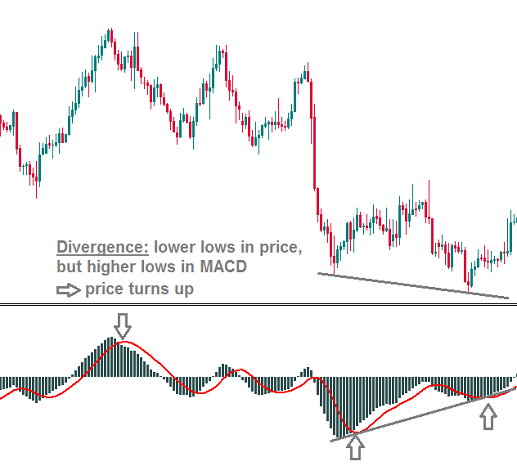
  4. Divergence. If a price rises and a MACD falls, it means that the advance of the price is not confirmed by the indicator and the rally is about to end. On the contrary, if a price falls and MACD rises, a bullish turn in the near-term.
MACD forex indicator
Tips
  • Crossovers between the histogram and the signal line are the best signal from MACD.
  • Hunt for divergences between MACD and the price: it’s a good indication of an upcoming correction.
Advantages of MACD:
  • MACD can be used both trending or ranging markets.
  • If you understood MACD, it will be easy for you to learn how other oscillators work: the principle is quite similar.
Disadvantages of MACD:
  • The indicator lags behind the price chart, so some signals come late and are not followed by the strong move of the market.
Conclusion
It’s good to have MACD on your chart as it measures both trend and momentum. It can be a strong part of a trading system, although we don’t recommend to make trading decisions based only on this indicator.

What have we learned about technical indicators

  • Technical indicators have both advantages and disadvantages.
  • One technical indicator won’t give you a good trading signal. You need to use 2-4 indicators for trading.